
What retrieval augmented generation means for AI systems
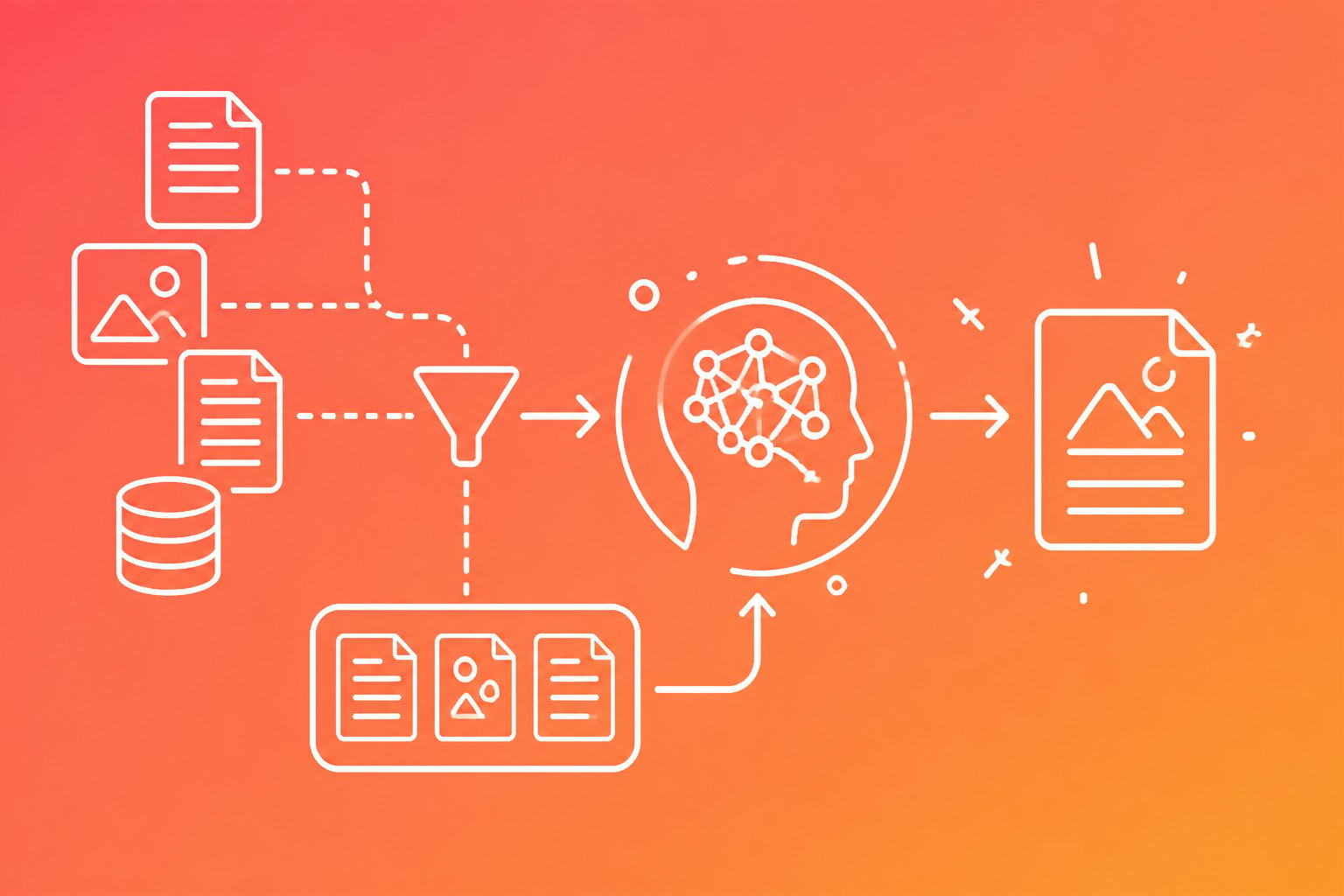
Retrieval-augmented generation, or RAG, connects large language models (LLMs) to external knowledge. It retrieves relevant information and gives that context to an LLM so the model can generate a more informed answer. This approach helps teams use current, specialist or organisation-specific content without retraining the model.
A RAG system depends on both retrieval and generation. Its results reflect the quality of the indexed information, the search method and the model’s ability to use the retrieved context. The article explains how the pipeline works, why teams use it and where its limits matter.
Key takeaways
- RAG links LLMs with external knowledge.
- Retrieval supplies context for generation.
- Quality depends on data, search and model behaviour.
The meaning of retrieval, augmentation and generation
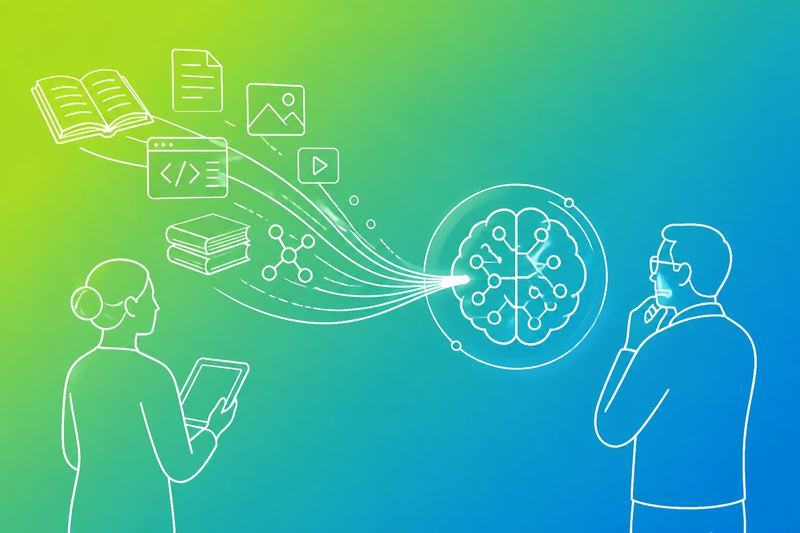
RAG combines information retrieval, prompt construction and language generation. A retriever identifies relevant material, the system adds that material as context and a generator model writes an answer based on the resulting prompt.
Retrieval finds evidence for a user query
Retrieval starts with the user query. A retriever module searches a defined collection, such as manuals, policies, tickets or database records, rather than relying only on the knowledge stored in a pre-trained language model.
The retrieval process may use keyword matching, vector search or a combination of both. Keyword search can find exact terms, while vector search can match related meanings. The system then ranks the results and passes selected passages, called retrieved data or retrieved knowledge, to the next stage.
Operators should test retrieval separately from answer quality. Useful checks include whether the correct document appears in the results, whether important passages rank highly and whether irrelevant text crowds out useful evidence. Poor retrieval limits the answer even when the generator can reason well.
Augmentation adds retrieved context to the prompt
Augmentation inserts selected evidence into the prompt sent to the LLM. The added context can include document excerpts, metadata, access dates or instructions that tell the generator how to use the material.
Prompt engineering controls how this information appears. A well-formed prompt can identify the user’s question, separate instructions from evidence and require the model to state when the retrieved material does not answer it. It can also ask for quotations, citations or structured fields when the application needs traceability.
The context window limits how much retrieved data the system can include. Ranking, filtering and passage size therefore matter. Sending more text does not automatically improve results. Repeated or contradictory passages can make the generator less reliable.
Generation produces a grounded response
Generation uses the augmented prompt to produce a response. The generator, typically an LLM such as a GPT or BART-based model, applies its natural language processing capabilities to the query and the retrieved context.
Grounding depends on both stages. The generator should rely on relevant evidence, preserve important conditions and avoid presenting unsupported details as facts. However, retrieved text does not guarantee accuracy. Documents can be outdated, incomplete or incorrectly ranked, and the model can still misread or combine them incorrectly.
Evaluation should compare the response with the retrieved passages. Reviewers can check factual support, completeness, citation accuracy and refusal behaviour when the evidence is insufficient. This separates retrieval failures from generation failures and gives operators a clearer basis for improving the system.
How a RAG pipeline works in practice
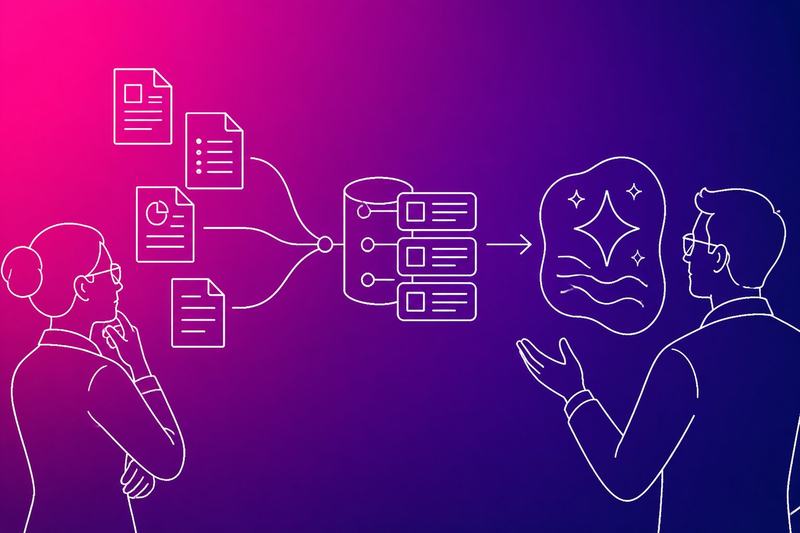
A RAG pipeline turns documents, databases and APIs into searchable context for a language model. Its quality depends on clean data preparation, useful embeddings, precise retrieval, effective reranking and regular knowledge-base updates.
Preparing documents and external data sources
The pipeline starts by collecting an external knowledge base from approved data sources. These may include policy documents, product manuals, support tickets, databases, APIs and structured data such as tables or a knowledge graph.
Each record needs useful metadata, including its title, author, publication date, access permissions and source location. Operators should remove duplicate files, identify outdated versions and preserve relationships between related records. A document parser may extract text from PDFs, web pages and office files, while a database connector can read selected fields without copying an entire database.
Chunking divides long documents into smaller passages that retrieval can return as context. Chunks should preserve headings, lists, table meanings and nearby definitions. Poor chunking can separate a warning from the procedure it qualifies, which gives the model incomplete evidence.
Creating embeddings and search indexes
An embedding model converts each chunk into a numerical representation called a vector. Similar meanings produce vectors that sit closer together in the embedding space, allowing semantic search to find relevant passages even when the query and document use different words.
The pipeline stores dense vectors in a vector database alongside the original text and metadata. It then builds an index that supports vector search, often using a similarity measure such as cosine similarity or dot product. The choice of embedding model matters because a model trained for general text may perform poorly on legal, technical or multilingual material.
Keyword indexing remains useful. A hybrid retrieval design combines vector search with lexical search such as BM25, then merges or reranks the results. This approach can match both conceptual questions and exact identifiers, product codes or error messages.
Ranking results before they reach the model
Initial retrieval usually returns more passages than the model should read. A reranker examines the query and each candidate passage together, then orders them by estimated relevance. It can remove passages that share keywords but fail to answer the specific question.
Operators should set a retrieval depth, apply metadata filters and remove duplicate or near-duplicate chunks. Filters can restrict results by customer, region, document status or publication date. Query expansion can add recognised synonyms or alternate terms, while structured queries can target databases or APIs when the answer requires current fields rather than prose.
The final context should retain the passage text and enough citation metadata to trace each claim. Evaluation should measure retrieval recall and ranking quality separately from answer quality. Test cases should include ambiguous queries, exact-match queries, missing information and conflicting documents.
Refreshing the knowledge base
A knowledge base needs an update process that detects changed, added and withdrawn content. Connectors can poll databases and APIs, while scheduled jobs can inspect document repositories. Each item should carry a stable identifier and version or modification timestamp so the pipeline can reprocess only affected content.
When content changes, the pipeline should reparse it, recreate its chunks and embeddings, then update the relevant indexes. It should retire obsolete vectors instead of leaving older passages available for retrieval. Access permissions also require refreshes because a user must not receive text from a document they can no longer view.
Operators should test ingestion failures, malformed files, broken API responses and incomplete updates. A review record can show which knowledge library version supported an answer. Evaluation sets should be rerun after significant changes to check whether retrieval improves, regresses or introduces conflicting context.
Why RAG is used, its limits and where it fits
RAG connects a large language model to external knowledge sources so it can use current, private or specialised information at query time. Its value depends on retrieval accuracy, contextual relevance and measured answer quality, while its limits include latency, context-window constraints and unsupported model responses.
Addressing knowledge cutoffs and domain-specific questions
A model’s knowledge cutoff limits what it can answer from training alone. RAG can retrieve newer material, such as revised policies, product documentation, clinical guidance or internal records, before the model generates an answer. It can also expose domain-specific data that was not part of general training.
The retrieved collection might support customer service, healthcare information workflows, education tools, research, content creation or question-answering systems. For example, a customer-support assistant can search approved troubleshooting articles, while an educational tool can retrieve content from a defined course library.
RAG does not make unsuitable data reliable. Operators should control document ownership, access permissions, update processes and metadata. They should also check whether the retrieved passage actually answers the question. A specialised data set can still contain omissions, conflicting versions or ambiguous terminology.
Reducing hallucinations without treating sources as proof
RAG can reduce some AI hallucinations by giving the model relevant passages instead of requiring it to rely only on learned patterns. It cannot guarantee factual answers. The model may misread a passage, combine details from separate documents or answer confidently when retrieval returns weak evidence.
A production workflow should require the answer to stay within the retrieved material where appropriate. It should also allow the system to say that the available documents do not support an answer. Citations, quoted passages or document identifiers improve transparency, but they do not prove that the answer interpreted the material correctly.
Evaluation should compare responses with a labelled set of questions and approved answers. Reviewers can check factual accuracy, citation alignment, completeness and refusal behaviour. This matters in healthcare, customer service and other settings where an unsupported answer may require escalation rather than further generation.
Choosing RAG rather than fine-tuning
RAG usually fits tasks that need changing, private or traceable information. It lets operators update documents without retraining the model and can limit access to content based on user permissions. This suits chatbots, AI assistants, virtual assistants and agentic AI workflows that must consult policies, catalogues or operational records.
Fine-tuning changes model behaviour through additional training. It can help with a consistent output format, specialised terminology or a defined interaction style, but it does not provide a dependable mechanism for storing frequently changing facts. Fine-tuning also requires suitable training data and controlled testing.
The options can work together. A system might fine-tune formatting behaviour while using RAG for current documents. Frameworks and managed services support parts of these workflows, but the choice should follow data access, governance, retrieval and evaluation requirements rather than vendor branding.
Testing retrieval accuracy, answer quality and latency
Operators should test the retrieval and generation stages separately. A retrieval test can measure whether the correct document or passage appears in the returned set and whether the passage contains enough context. It should include exact questions, paraphrases, ambiguous terms, outdated documents and queries with no valid answer.
Answer testing should check groundedness, factual accuracy, completeness, citation alignment and appropriate refusal. A useful test record links each question to the retrieved passages, final answer, model version, prompt configuration and evaluation result. Human review remains important for specialist areas where automatic scoring can miss dangerous interpretations.
Latency also affects the design. Query rewriting, vector search, reranking, document access and generation each add time. Operators should measure response time under realistic load and track failures caused by long context windows, slow data stores or excessive retrieved text. They can then adjust chunking, top-k retrieval, reranking and context limits based on measured results.
Frequently asked questions
RAG connects a language model to retrievable documents, allowing answers to use current or organisation-specific information. Its value depends on retrieval quality, document accuracy and how clearly the system separates retrieved evidence from unsupported generation.
What is RAG in AI?
RAG means retrieval-augmented generation. It combines a retrieval system with a generative language model.
The system searches an approved collection, such as technical documents, policies or database records. It then supplies relevant passages to the language model as context for the response. This approach lets the model use information outside its original training data. Microsoft’s explanation of RAG describes the same retrieval and generation pattern.
How does retrieval-augmented generation work?
A typical RAG pipeline follows these steps:
- Documents are collected, cleaned and divided into searchable passages.
- The passages are indexed using keyword search, vector search or both.
- A user submits a question.
- The retrieval layer finds passages that match the question.
- The system adds those passages to the model’s prompt.
- The model generates an answer using the supplied context.
The system can also apply filters, reranking and access controls before generation. These controls help it retrieve the right records and prevent users from receiving documents they cannot access.
What is a practical example of retrieval-augmented generation?
A company can connect RAG to its internal support handbook. When an employee asks how to report a security incident, the system retrieves the relevant policy section and uses it to draft an answer.
If the handbook changes, the team can update the indexed documents rather than retrain the language model. The answer still depends on whether the index contains the latest approved policy and whether retrieval returns the correct passage.
How does RAG improve large language model responses?
RAG can improve responses by supplying relevant evidence at query time. It can also reduce reliance on information stored only in the model’s training parameters, which may be outdated or unrelated to the organisation’s documents. Published guidance explains how RAG grounds responses in an external knowledge base.
RAG does not guarantee accuracy. Poorly indexed documents, weak search results or conflicting records can produce an incorrect answer. Operators should test retrieval separately from generation and measure whether the system returns the right passages for representative questions.
Is a general chat assistant a RAG-based system?
A general chat assistant is not, by definition, a single fixed RAG system. A deployment can connect a chat model to search, files, databases or other retrieval tools, creating a RAG workflow.
A model can also answer directly from its learned parameters or from information supplied in the conversation. Therefore, the label depends on the specific product configuration and whether it retrieves external content during the request.
How can you explain RAG in an interview?
They can describe RAG as search first, then generate. The system retrieves relevant content from a controlled collection and gives that content to a language model to support its answer.
A stronger explanation also covers the operational risks. They should mention document chunking, indexing, access control, retrieval evaluation, prompt construction, citation handling and tests for unsupported claims. A technical overview of RAG provides the core distinction between retrieved context and the model’s learned parameters.