
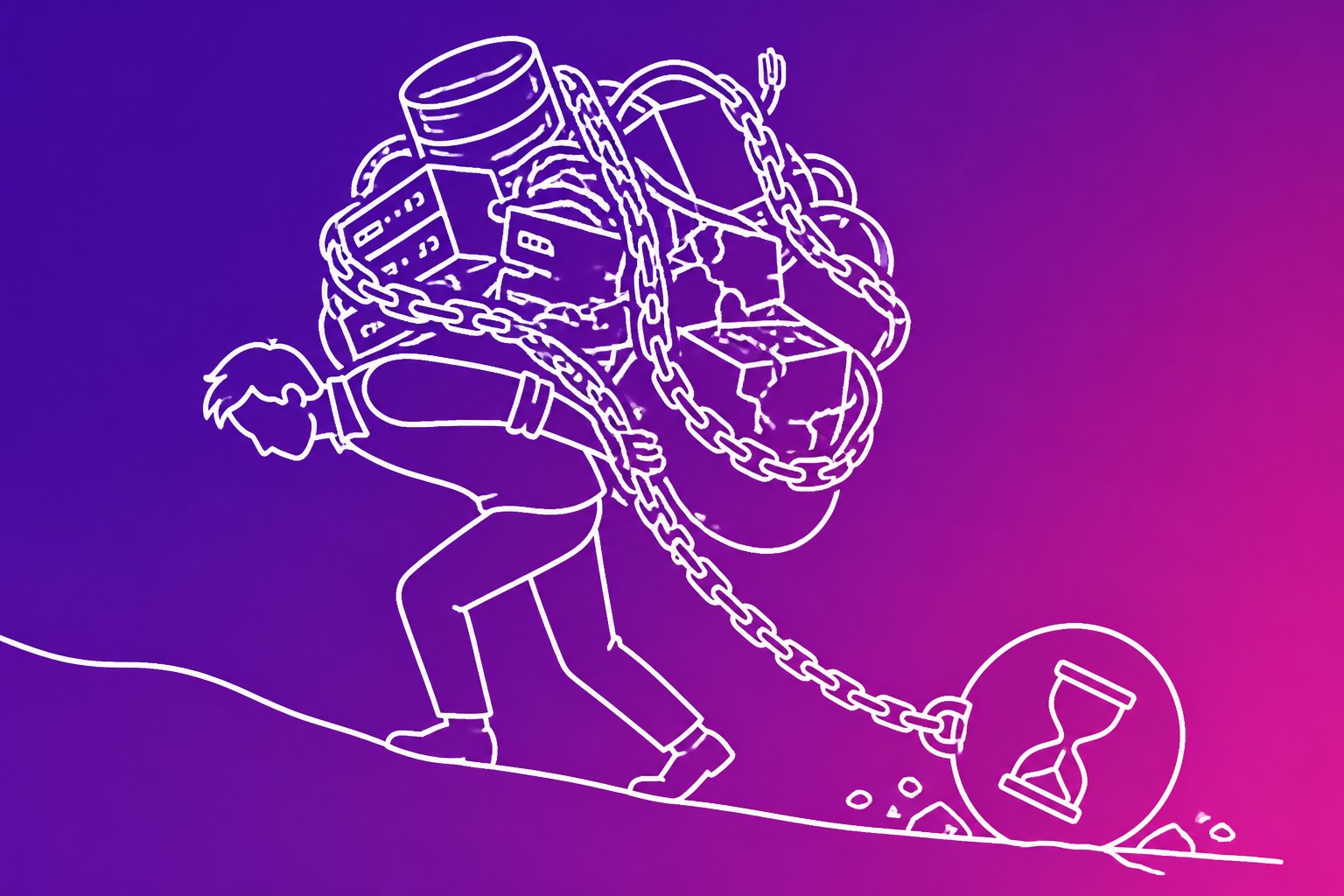
What technical debt really costs your operations
Technical debt is the future cost created when software development chooses speed or convenience over a sounder solution. Ward Cunningham introduced the idea to show that these shortcuts create obligations that teams must manage, not ignore.
The cost of technical debt appears in slower delivery, more fragile changes, higher maintenance effort and greater operational risk. It can also affect customer retention, planning confidence and the business’s ability to respond to new opportunities.
This article shows where tech debt costs emerge, how different debt types create recurring failure patterns and how teams can measure, prioritise and reduce the burden without stopping useful delivery.
Key takeaways
- Technical debt increases delivery effort and operational risk.
- Different debt types create different failure patterns.
- Teams can reduce the burden through measurement and prioritisation.
Where the cost shows up in delivery and the business

Technical debt consumes engineering capacity through rework, manual maintenance and operational support. It also extends lead time, delays feature delivery and increases the business impact of failures, security vulnerabilities and unreliable data.
Engineering time, development costs and maintenance load
Technical debt turns planned development into unplanned maintenance. Engineers spend time tracing fragile dependencies, repairing workarounds, supporting outdated components and checking whether a change has broken an unrelated part of the system.
That effort increases development costs without necessarily improving the product. A useful operating view separates new capability, software maintenance, incident work and debt reduction. If teams do not track those categories, productivity loss remains hidden inside delivery estimates.
Debt also raises the cost of routine change. A small request may require manual database updates, duplicated tests or coordination across systems with unclear ownership. Engineering capacity then becomes less flexible. The business pays through slower delivery, higher maintenance costs and more time spent keeping existing services running.
Slower feature delivery and lost opportunity
Technical debt lengthens lead time for changes. Engineers need more time to understand the system, make a safe modification, test its side effects and complete a release. Manual approval steps and tightly coupled services can extend release cycles even when the feature itself is small.
The business loses options when delivery slows. A delayed pricing change, customer integration or regulatory feature may miss its useful window. Competitors may reach the market first, sales teams may lose a deal and customers may wait longer for a capability they consider essential. These are opportunity costs, even when the accounting system records only staff time.
Teams can expose this cost by measuring planned work against rework, support effort and delays. Persistent slippage indicates that development velocity reflects system friction as much as team capacity.
Reliability, security and operational exposure
Technical debt increases operational costs when systems require manual intervention, specialist knowledge or repeated incident response. Fragile integrations can fail at handover points, while poor observability makes diagnosis slower and extends service disruption.
Old dependencies, unsupported components and inconsistent access controls can create security risk. Debt does not automatically cause a data breach, but it can leave vulnerabilities unpatched or make their impact harder to contain. The resulting business impact may include lost revenue, contractual penalties, recovery work and reduced customer trust.
Operators should connect engineering records with production signals: incident hours, failed deployments, rollback frequency, emergency changes and unresolved vulnerabilities. This shows where reliability and security exposure consume engineering capacity and where maintenance work needs priority.
Debt types and the failure patterns they create

Technical debt appears in code, tests, design decisions, architecture, infrastructure, processes and operational knowledge. Each type creates a different failure pattern, from slow changes and unreliable releases to fragile authentication, unclear ownership and expensive modernisation.
Code, test and design debt
Code-level debt includes duplicated logic, unclear names, oversized modules and recurring code smells. Bad code increases the effort required to make a safe change because engineers must first discover hidden dependencies. Declining code quality also makes defects harder to isolate, particularly in legacy code with little ownership.
Test debt creates a different risk. A thin test suite, weak test coverage or heavy reliance on manual QA leaves regressions undetected until staging or production. Teams then reduce release frequency, add excessive approval steps or avoid changes in high-risk areas.
Design debt sits between implementation and architecture. A database schema may reflect old business rules, while interfaces may force unrelated features through the same path. These constraints encourage more patches, increase coupling and make an apparently small change affect several services.
Architecture and platform constraints
Architectural debt develops when system boundaries no longer match the business or operational model. Tightly coupled components share data, deployment schedules and failure modes, so one change can require coordinated releases across multiple teams. Microservices do not remove this problem when services share databases, lack clear contracts or depend on synchronous chains.
The failure pattern often appears during growth. A legacy application may handle routine traffic but fail to scale specific workloads independently. Engineers add caching, queues or replicas without addressing the underlying boundary, which increases operational complexity.
Legacy systems also constrain legacy application modernisation. Authentication, reporting or billing may depend on undocumented behaviour in an older application. Replacing one component without mapping those dependencies can break data integrity, access control or downstream processes.
Infrastructure, process and knowledge gaps
Infrastructure debt accumulates when environments, hosting patterns and operational controls fall behind system needs. An unreliable deployment pipeline, inconsistent environments or incomplete CI/CD pipelines can turn a routine release into a manual operation. Weak observability then delays detection because logs, metrics and traces do not show where a failure began.
Process debt appears in unowned approvals, unclear incident procedures and repetitive hand-offs. These controls can conceal system risk rather than reduce it, especially when teams cannot measure deployment outcomes or recurring failure causes.
Documentation gaps create a knowledge dependency. Tribal knowledge may explain why an authentication exception exists, how a database migration must run or which legacy system owns a field. When those engineers leave or rotate, the system becomes fragile because the organisation loses the reasoning needed to change it safely.
Measuring, prioritising and reducing the burden
Technical debt management works best when teams connect engineering signals to delivery cost, customer risk and the IT budget. A measured baseline supports a targeted remediation plan, while disciplined development practices stop new debt from compounding.
Build a practical cost baseline
Engineering teams should record where debt sits, why it exists and what it disrupts. Useful evidence includes defect rates, lead time, change failure rate, recovery time, security findings and the hours spent on manual work. Teams should also track maintainability indicators such as duplicated code, outdated dependencies, test coverage and failed builds.
A technical debt ratio (TDR) can compare estimated remediation effort with the cost of developing the affected component from scratch. The ratio provides a comparison point, not a complete valuation. Teams should add customer impact, regulatory exposure, platform dependency and the opportunity cost of delayed product work.
Measure What it reveals Lead time How long changes take to reach production Change failure rate How often releases cause incidents or rework Defect rates Where poor software quality affects users Remediation effort The approximate cost of reducing the debtChoose what to refactor, modernise or leave alone
Teams should prioritise debt where it blocks important product changes, creates recurring incidents or exposes the organisation to material security and compliance risk. Martin Fowler’s technical debt quadrant helps explain whether debt was deliberate or inadvertent and whether the decision was prudent or reckless. It does not replace risk management or a decision based on system impact.
A remediation plan should assign an owner, define the desired outcome and estimate the work. Refactoring often suits a stable component with clear tests. Application modernisation may fit an ageing platform that limits deployment or scaling. A full rewrite deserves a high evidential threshold because it can preserve old assumptions while adding migration risk.
Due diligence should include dependency health, operational history, architecture boundaries and security testing, including penetration testing where appropriate. Teams can then leave low-risk debt alone when its interest remains cheaper than remediation.
Prevent new debt from compounding
Teams reduce new debt by making quality part of the development process rather than a later clean-up task. Coding standards, focused code review, automated testing and continuous integration should block predictable defects before they reach production. CI/CD pipelines should also enforce dependency checks, security controls and rollback readiness.
DevOps practices become more effective when teams own the full path from change to operation. Infrastructure as code keeps environments reviewable and reproducible, while observability exposes rising failure rates and slow recovery. The scout rule provides a practical standard: teams should leave a component cleaner than they found it, without turning every change into a redesign.
Product and platform owners should reserve capacity for remediation and review debt during planning. This protects long-term sustainability without treating every imperfect implementation as a crisis.
Frequently asked questions
Technical debt turns short-term delivery choices into future rework, slower change and operational risk. Its impact becomes clearer when teams connect code quality to delivery time, maintenance effort, failure rates and business priorities.
What does technical debt mean in software development?
Technical debt describes the future effort created when a team chooses a quick, incomplete or poorly understood solution instead of a more durable one. The debt may involve code, architecture, tests, documentation, infrastructure or development processes.
Like financial debt, technical debt can support useful investment when teams control its cost. It becomes harmful when teams ignore the work needed to repay it and continue building on unstable foundations.
What are common examples of technical debt?
Common examples include duplicated logic, complex modules, missing automated tests, outdated dependencies and unclear interfaces between services. Hard-coded configuration, manual deployment steps and undocumented operational procedures also create debt.
Teams can also create architectural debt by choosing boundaries that do not match the system's responsibilities. For example, one service may own data that several unrelated domains need, creating tight coupling and making independent changes difficult.
Frequent bugs in the same area, long lead times for small changes and a lack of tests often indicate technical debt in a codebase.
How does technical debt affect software delivery and maintenance costs?
Technical debt increases the effort required to understand, change and test software. Engineers may need to work around fragile code, investigate recurring failures or make changes in several places instead of one.
It can also increase operational costs through manual recovery, avoidable incidents and extended support work. When deployment becomes risky, teams release less often or add extra approval steps, which delays product changes and reduces feedback from users.
The business impact includes slower feature delivery, higher maintenance effort and reduced ability to adapt. These effects form the measurable business cost of technical debt, although the amount varies by system, team and workload.
How much technical debt is acceptable?
No fixed level suits every system. A team can accept limited debt when the decision has a clear purpose, the risk remains contained and the repayment work has an owner and a target date.
Teams should treat debt as unacceptable when it threatens data integrity, security, regulatory obligations or reliable service operation. Debt also needs urgent attention when it repeatedly blocks planned work or causes incidents.
A useful decision record should state why the shortcut exists, what it costs, which risks it creates and when the team will review it. This keeps deliberate trade-offs separate from neglected problems.
How can teams measure and prioritise technical debt?
Teams can measure debt through indicators such as cycle time for changes, defect rates, incident frequency, failed deployments, test coverage in critical paths and time spent on rework. They should compare these measures across components rather than rely on a single score.
Each item should include its location, observed symptom, likely cause, affected users or services and estimated remediation effort. Teams can then rank items by risk reduction, delivery impact, customer impact and cost of delay.
A practical backlog might prioritise a security weakness before a minor refactoring task, then address a shared dependency that slows several teams. Teams should reserve capacity for repayment while continuing product delivery, rather than waiting for a separate large-scale rewrite.
Can AI reduce technical debt, or create more of it?
AI can help teams identify duplicated code, explain unfamiliar modules, draft tests, update documentation and suggest dependency changes. Engineers still need to verify the output against system behaviour, security requirements and operational constraints.
AI can also create debt when teams accept generated code without clear ownership, testing or design review. Repeatedly generated patches may increase duplication, obscure boundaries or add dependencies that the team cannot maintain.
Teams should apply the same controls to AI-assisted changes as to other changes: defined interfaces, automated tests, reviewable commits, dependency checks and production monitoring. AI reduces debt only when it strengthens these controls rather than bypassing them.